


When it comes to automotive suspension and steering systems, three essential components are often confused: ball joints, tie rod ends, and stabilizer links.
Although these parts may look similar and often use ball-and-socket joints, they perform different functions in a vehicle.
Understanding the differences between a ball joint, a tie rod end, and a stabilizer link is important for vehicle maintenance, repair shops, and automotive parts distributors.
In this guide, we’ll explain how these components work, their main differences, common failure symptoms, and how to choose reliable replacement parts.
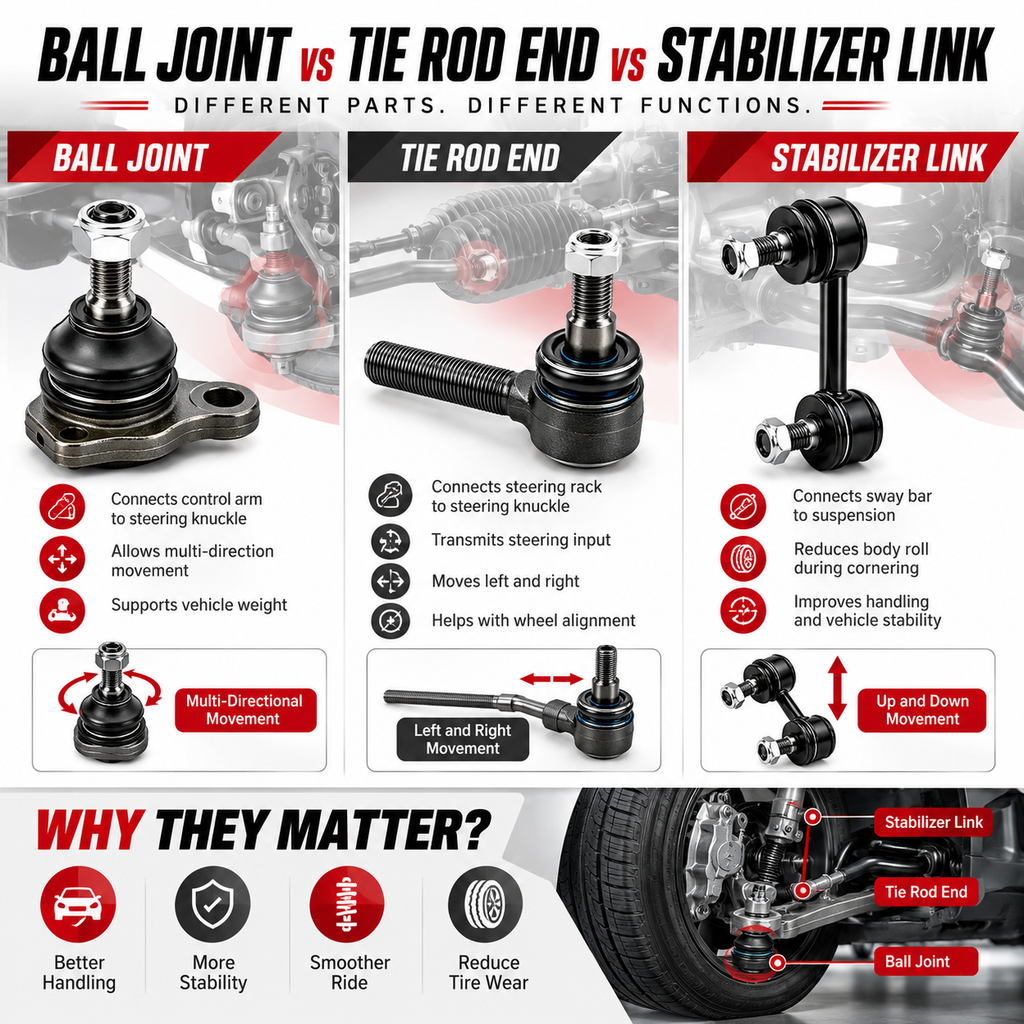
1. What Is a Ball Joint?
A ball joint is an important suspension component that connects the control arm to the steering knuckle in many vehicle designs.
It acts as a flexible pivot point, allowing the suspension to move while enabling the front wheels to turn.
Main Functions of a Ball Joint
- Connects suspension components: Links the control arm and steering knuckle.
- Allows multi-directional movement: Supports steering and suspension articulation.
- Handles suspension loads: Depending on the design, some ball joints carry significant vehicle loads.
- Maintains wheel positioning: Helps maintain proper suspension geometry and wheel control.
Common Symptoms of a Bad Ball Joint
Worn or damaged ball joints may cause several problems:
- Clunking or knocking noises over bumps.
- Excessive looseness in the suspension.
- Uneven tire wear.
- Poor steering response.
- Vibration or instability while driving.
A severely worn ball joint may create a serious safety risk. Regular inspection and timely replacement are essential.
Common applications: Passenger cars, SUVs, pickup trucks, and light commercial vehicles.
2. What Is a Tie Rod End?
A tie rod end is a steering system component that connects the steering linkage to the steering knuckle.
Its main purpose is to transmit steering movement so the wheels turn in the direction selected by the driver.
Tie rod ends are commonly divided into inner and outer tie rod assemblies, depending on the steering system design.
Main Functions of a Tie Rod End
- Transfers steering force: Connects the steering mechanism to the wheels.
- Controls steering direction: Helps the front wheels turn left and right.
- Allows joint articulation: Accommodates suspension and steering movement.
- Maintains steering accuracy: Helps preserve correct steering geometry and toe alignment.
Common Symptoms of a Bad Tie Rod End
When a tie rod end begins to wear out, drivers may notice:
- Loose or imprecise steering.
- Steering wheel vibration.
- Uneven or accelerated tire wear.
- Knocking sounds during steering.
- Excessive play in the steering linkage.
Damaged tie rod ends can negatively affect steering control and vehicle safety.
After replacing a tie rod end, checking and adjusting wheel alignment is generally recommended.
Common applications: Toyota, Honda, Nissan, Hyundai, Kia, Ford, and many other vehicle brands.
3. What Is a Stabilizer Link?
A stabilizer link, also known as a sway bar link or anti-roll bar link, connects the stabilizer bar to a suspension component such as a control arm or strut.
Unlike tie rod ends, stabilizer links are not responsible for directly controlling steering direction.
Instead, they help the stabilizer bar reduce excessive vehicle body roll during cornering.
Main Functions of a Stabilizer Link
- Connects the stabilizer bar: Transfers forces between the sway bar and suspension.
- Reduces body roll: Helps limit excessive vehicle leaning during turns.
- Improves handling stability: Supports more controlled cornering.
- Allows suspension articulation: Accommodates suspension movement through its joints or bushings.
Common Symptoms of a Bad Stabilizer Link
A worn stabilizer link may cause:
- Rattling or knocking noises on uneven roads.
- Increased body roll during cornering.
- Reduced handling stability.
- Excessive play in the link joints.
- Damaged or worn rubber boots and bushings.
Stabilizer links are widely used in modern passenger cars, SUVs, and commercial vehicles.
They are also frequently called sway bar end links in the automotive aftermarket.
4. Ball Joint vs Tie Rod End vs Stabilizer Link: Key Differences
The easiest way to understand these three automotive components is to compare their primary functions.
Ball Joint: Suspension Movement
A ball joint connects suspension components and allows movement between the control arm and steering knuckle.
It plays an essential role in suspension articulation, wheel positioning, and vehicle control.
Tie Rod End: Steering Control
A tie rod end transfers steering input to the steering knuckle.
Its main job is to help control the direction of the wheels while accommodating suspension movement.
Stabilizer Link: Vehicle Stability
A stabilizer link connects the anti-roll bar to the suspension.
Its primary purpose is to transfer forces that allow the stabilizer bar to resist excessive body roll during cornering.
Quick Comparison
- Ball Joint: Suspension articulation and wheel positioning.
- Tie Rod End: Steering transmission and directional control.
- Stabilizer Link: Body roll reduction and cornering stability.
Although these components share some structural similarities, they cannot replace one another because they serve different mechanical purposes.
5. Why Are These Suspension and Steering Parts Important?
Ball joints, tie rod ends, and stabilizer links all contribute to vehicle performance, comfort, and safety.
Better Vehicle Handling
Properly functioning steering and suspension components help drivers maintain predictable vehicle control.
Improved Driving Stability
Healthy ball joints and stabilizer links help the suspension work correctly, especially when driving over uneven roads or around corners.
More Comfortable Driving
Suspension components in good condition help reduce unwanted noises, vibrations, and excessive vehicle movement.
Reduced Abnormal Tire Wear
Correct steering and suspension geometry helps prevent uneven tire wear and supports longer tire service life.
Safer Driving Performance
Regular inspection of these parts can help identify excessive wear before it leads to more serious steering or suspension problems.
6. How to Choose High-Quality Suspension Parts
For automotive parts importers, distributors, repair shops, and wholesalers, selecting reliable suspension components is essential.
Here are several important factors to consider.
Material Quality
High-quality automotive suspension parts should use suitable steel materials, durable joint components, and protective surface treatments.
Precision Manufacturing
Accurate dimensions and controlled manufacturing tolerances help ensure correct installation and dependable performance.
Durable Rubber Components
Protective boots and rubber bushings should resist premature cracking, deformation, and environmental damage.
Quality Inspection
Consistent manufacturing inspection and relevant performance testing help reduce product defects and improve quality consistency.
Correct Vehicle Fitment
Always confirm the following information before purchasing replacement parts:
- OEM or OE reference number.
- Vehicle make and model.
- Production year.
- Engine variant when relevant.
- Installation position and suspension configuration.
Correct fitment is especially important for wholesale orders covering multiple vehicle applications.
7. Wholesale Ball Joints, Tie Rod Ends, and Stabilizer Links from Topshine Auto Parts
Finding a dependable automotive suspension parts manufacturer and supplier is important for maintaining stable product quality and reliable inventory.
At Topshine Auto Parts, we specialize in automotive suspension, steering, and chassis replacement parts for global aftermarket customers.
Our main product categories include:
- Ball Joints
- Inner and Outer Tie Rod Ends
- Stabilizer Links
- Control Arms
- Suspension Bushings
- Engine Mounts
- Strut Mounts
- Shock Absorbers
Why Choose Topshine Auto Parts?
Wide Product Range
We offer a broad selection of aftermarket suspension and steering components for Japanese, Korean, American, European, and Chinese vehicle applications.
Factory-Direct Supply
Our factory-direct sourcing solutions help automotive parts importers and distributors obtain competitive wholesale prices.
Quality-Focused Manufacturing
We emphasize product inspection, dimensional accuracy, and consistent quality throughout our production and supply processes.
Flexible Wholesale Solutions
We support different wholesale purchasing requirements, including flexible order quantities and mixed-product sourcing.
Custom Branding and Packaging
We offer customized product boxes, printed packaging bags, product labels, and private-label packaging solutions for distributors.
One-Stop Automotive Parts Sourcing
Customers can source multiple suspension and steering product categories from one supplier, simplifying purchasing and inventory management.
8. Frequently Asked Questions
Q1: Is a ball joint the same as a tie rod end?
No. A ball joint is primarily part of the suspension system, while a tie rod end is part of the steering linkage. Both may use ball-and-socket joints, but they perform different functions.
Q2: Can a bad stabilizer link affect steering?
A worn stabilizer link does not directly control steering direction. However, it can cause noise, increased body roll, and changes in handling feel.
Q3: What is the difference between a stabilizer link and a sway bar link?
There is generally no difference. Stabilizer link, sway bar link, and anti-roll bar link are common names for the same type of component.
Q4: Which is more important, a ball joint or a tie rod end?
Both are critical components. Ball joints are essential for suspension movement and wheel control, while tie rod ends transmit steering input. Severe failure of either component can compromise vehicle control.
Q5: How often should suspension parts be replaced?
There is no universal replacement interval. Service life depends on road conditions, driving habits, vehicle design, materials, and maintenance. These components should be inspected when symptoms appear and according to vehicle manufacturer recommendations.
Conclusion
Understanding the differences between ball joints, tie rod ends, and stabilizer links helps vehicle owners, mechanics, and automotive parts distributors select the correct replacement components.
Each part performs a unique function:
- Ball joints allow suspension articulation and help maintain wheel positioning.
- Tie rod ends transfer steering movement to control wheel direction.
- Stabilizer links help reduce vehicle body roll and improve handling stability.
Choosing properly fitted, high-quality suspension components is essential for reliable vehicle performance.
If you are looking for a professional supplier of wholesale ball joints, tie rod ends, stabilizer links, and other automotive suspension parts, Topshine Auto Parts is ready to support your business.
Contact Topshine Auto Parts
Website: https://www.topshineparts.com/
WhatsApp: +86 18070095538
Email: sales@topshineparts.com
Topshine Auto Parts — Your One-Stop Automotive Suspension Parts Supplier.