


The suspension system is essential to vehicle safety, ride comfort, steering stability, and tire contact with the road. Whether you are an auto parts distributor, wholesaler, repair chain, or aftermarket brand, choosing the right automotive suspension parts can directly affect product reliability, customer satisfaction, and long-term business performance.
This guide explains the main suspension components, common signs of wear, important purchasing factors, and how to select a dependable suspension parts manufacturer for your market.
What Is an Automotive Suspension System?
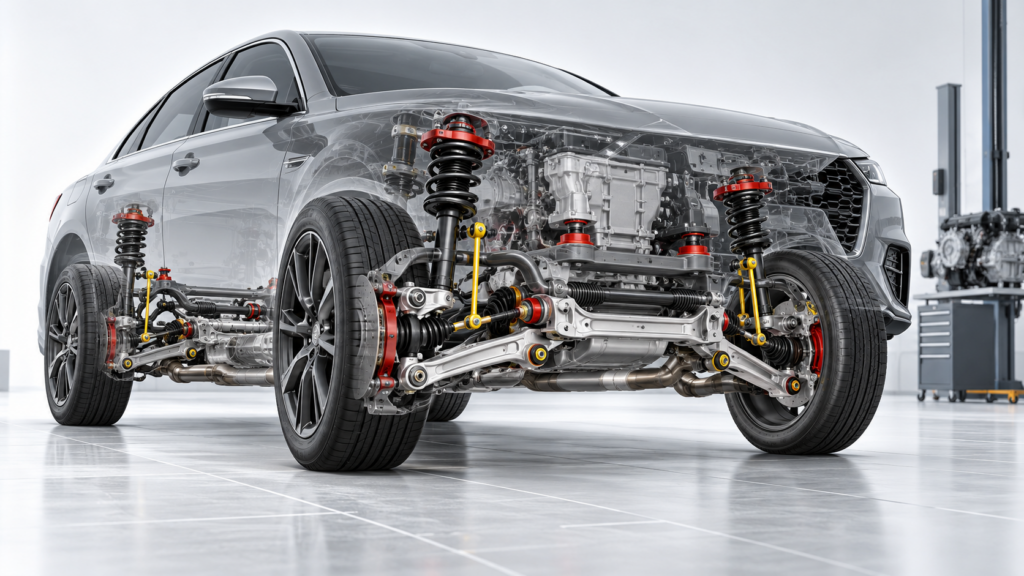
An automotive suspension system connects the vehicle body to the wheels while allowing controlled vertical movement. It absorbs road impacts, helps keep the tires in contact with the road, and supports accurate steering and braking.
A complete suspension and steering assembly includes both metal and rubber components. These parts must work together under repeated loads, vibration, heat, moisture, dust, and changing road conditions. Even a small worn component can cause noise, uneven tire wear, poor wheel alignment, or unstable handling.
For aftermarket buyers, correct fitment and consistent quality are therefore just as important as price.
Main Types of Automotive Suspension Parts
1. Control Arms
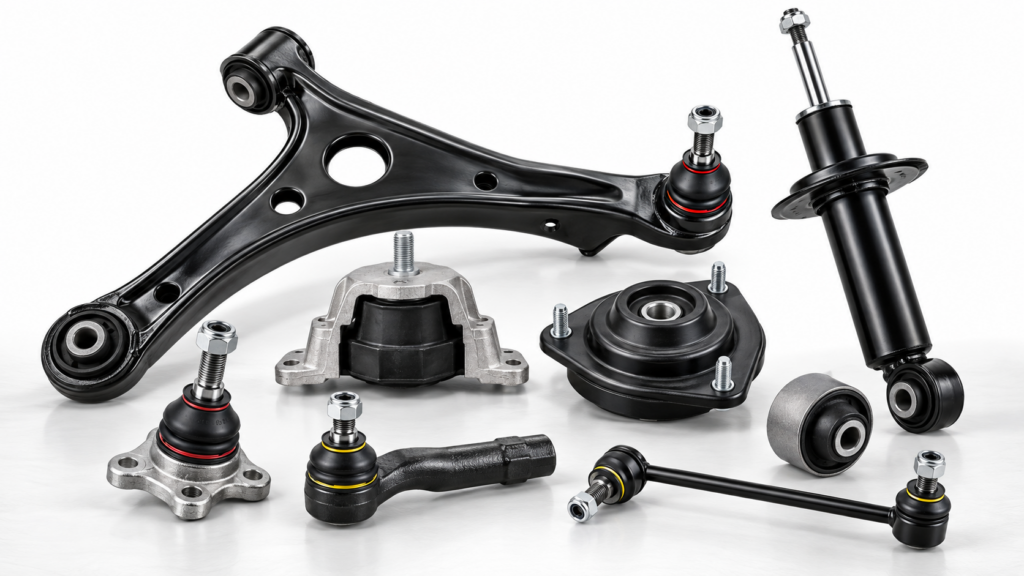
Control arms connect the wheel hub or steering knuckle to the vehicle frame. They guide wheel movement and help maintain proper suspension geometry.
A control arm assembly may include bushings and a ball joint. When worn, it can cause clunking noises, steering instability, uneven tire wear, or vibration. Buyers should check the material, welding quality, surface treatment, bushing hardness, ball-joint performance, and mounting dimensions.
2. Ball Joints
Ball joints act as flexible pivot points between the control arms and steering knuckles. They allow the wheels to move with the suspension while turning left or right.
Important quality points include stud strength, socket precision, grease performance, dust-boot sealing, and resistance to wear. A high-quality ball joint should provide smooth movement without excessive clearance.
3. Suspension Bushings
Suspension bushings reduce vibration, isolate noise, and allow controlled movement between connected metal components. They are commonly used in control arms, stabilizer bars, and other chassis positions.
Rubber formulation is especially important. A bushing that is too soft may reduce steering precision, while one that is too hard may transmit excessive vibration. Reliable manufacturers control rubber hardness, bonding strength, dimensions, and aging resistance to achieve stable performance.
4. Stabilizer Links
Stabilizer links connect the anti-roll bar to the suspension. They help reduce body roll during cornering and improve vehicle stability.
Common problems include damaged dust boots, looseness, corrosion, and worn internal joints. For wholesale purchasing, inspect thread accuracy, joint movement, surface coating, and boot sealing.
5. Strut Mounts
Strut mounts secure the upper part of the strut assembly to the vehicle body. Depending on the application, the mount may also include a bearing that supports steering rotation.
A worn strut mount can create knocking sounds, steering stiffness, vibration, or poor alignment. Good strut mounts require durable rubber, strong metal-to-rubber bonding, accurate dimensions, and reliable bearing performance.
6. Tie Rod Ends
Tie rod ends transfer steering input from the steering rack to the wheels. Although they belong to the steering system, they are closely related to suspension performance and wheel alignment.
Key inspection points include stud material, thread precision, ball-socket clearance, dust-boot quality, and corrosion protection. Correct OE number and vehicle application matching are essential because similar-looking tie rod ends may have different dimensions.
7. Shock Absorbers
Shock absorbers control spring movement and reduce repeated bouncing after the vehicle passes over bumps. They help improve tire contact, braking stability, and ride comfort.
Buyers should evaluate damping consistency, seal quality, piston-rod finish, oil leakage resistance, mounting accuracy, and road-condition suitability. Product selection may vary according to passenger cars, SUVs, commercial vehicles, and regional driving conditions.
8. Engine Mounts
Engine mounts support the engine and help isolate vibration from the vehicle body. Although they are not conventional wheel-suspension components, they are an important part of the vehicle’s vibration-control system and are often sourced together with automotive rubber and chassis parts.
High-quality engine mounts require dependable rubber compounds, strong bonding, accurate brackets, and application-specific stiffness. Hydraulic mounts also require careful sealing and stable fluid performance.
Common Signs That Suspension Parts Need Replacement
Drivers and repair technicians may notice several warning signs when suspension or steering components begin to wear:
- Knocking, squeaking, or clunking noises on uneven roads
- Excessive vibration in the steering wheel or vehicle body
- Uneven or rapid tire wear
- Vehicle pulling to one side
- Loose or imprecise steering
- Excessive body roll when cornering
- Longer braking distance or reduced stability
- Oil leakage from a shock absorber
- Visible cracks in rubber bushings or dust boots
These symptoms may be caused by more than one component. A complete inspection should be carried out before replacement, and wheel alignment may be required after installing certain suspension parts.
How to Choose the Right Suspension Parts
Confirm the OE Number and Vehicle Application
The safest starting point is the original equipment number. Buyers should also confirm the vehicle brand, model, production year, engine type, installation position, and left- or right-side requirements.
For bulk orders, a clear application list reduces incorrect shipments, customer complaints, and inventory problems.
Compare Dimensions and Product Structure
Two parts may look similar in photos but differ in bolt-hole spacing, thread size, stud angle, bushing diameter, or mounting position. Technical drawings, physical samples, and detailed measurements can help confirm compatibility.
Evaluate Materials and Manufacturing
Reliable aftermarket suspension parts depend on controlled raw materials and stable production. Depending on the component, buyers should examine:
- Steel or aluminum specifications
- Forging, casting, stamping, machining, and welding quality
- Rubber formula, hardness, and metal-to-rubber bonding
- Heat treatment and joint precision
- Anti-corrosion coating and surface finish
- Dust protection, sealing, and lubrication
Ask About Quality Inspection
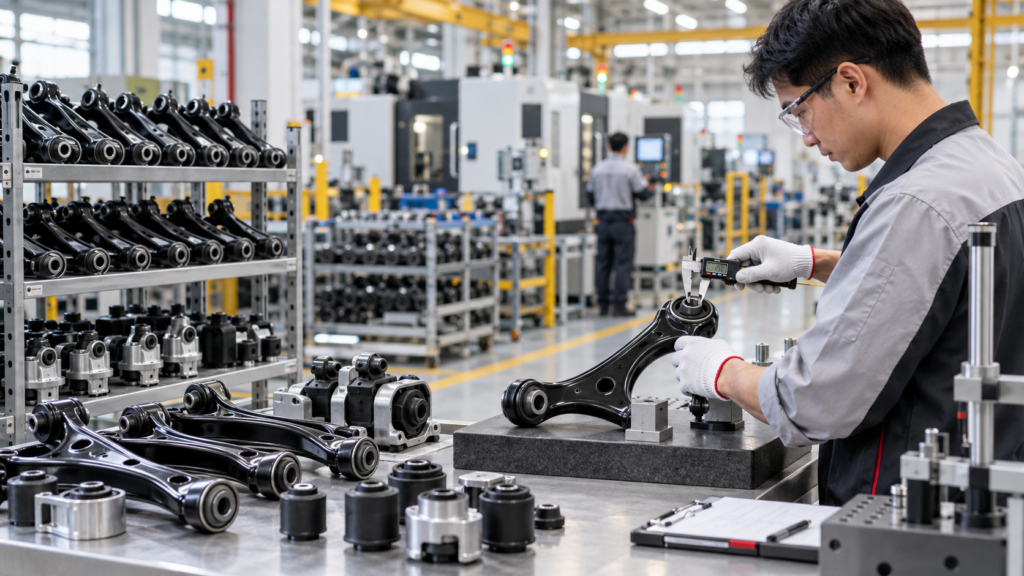
A professional suspension parts manufacturer should carry out inspections at the raw-material, production, assembly, and finished-product stages. Depending on the product, checks may include dimensions, hardness, tensile or fatigue performance, joint torque, salt-spray resistance, leakage, and appearance.
Importers should request product specifications, inspection information, samples, and packaging details before placing a large order.
Consider Packaging and Private-Label Requirements
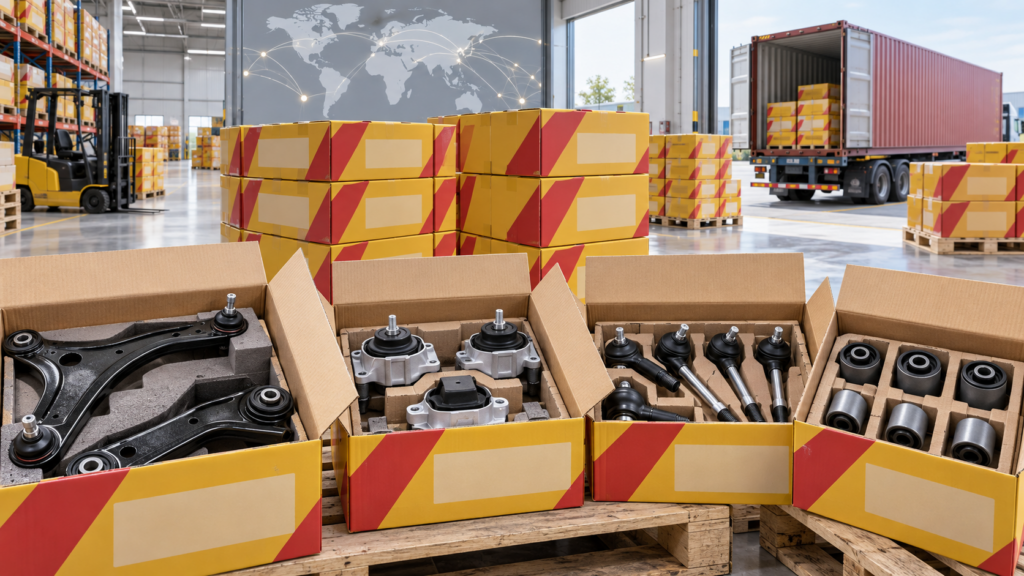
Packaging protects the product during storage and international transport while also presenting the buyer’s brand. Distributors may require neutral packaging, customized color boxes, poly bags, labels, barcodes, or private-label solutions.
Before production, confirm the packaging dimensions, material strength, printing artwork, labeling rules, packing quantity, and carton requirements. This is particularly important for heavy control arms, long stabilizer links, and parts with exposed threaded studs.
What Wholesale Buyers Should Look for in a Supplier
The right supplier should offer more than a low quotation. For stable long-term sourcing, consider the following:
- Product coverage: A broad range helps buyers consolidate control arms, ball joints, bushings, stabilizer links, tie rod ends, strut mounts, shock absorbers, and engine mounts in fewer orders.
- Fitment support: Accurate OE references and application data reduce purchasing errors.
- Consistent quality: Repeat orders should maintain stable dimensions, materials, function, and appearance.
- Development capability: Support for samples, drawings, and new product development helps buyers respond to market demand.
- Flexible packaging: Neutral and customized packaging options support wholesalers, distributors, and private brands.
- Responsive service: Clear communication about quotations, samples, production, inspection, and shipping improves supply-chain efficiency.
Why Work With Topshine Auto Parts?
Established in 2012, Topshine Auto Parts focuses on automotive rubber parts and suspension components for the global aftermarket. Our product range includes control arms, ball joints, bushings, stabilizer links, strut mounts, tie rod ends, shock absorbers, engine mounts, and related chassis parts for a wide variety of vehicle applications.
We support wholesalers, distributors, repair networks, and automotive aftermarket brands with product matching, bulk supply, new model development, and customized packaging solutions. Our goal is to help customers build a more competitive suspension parts range with reliable products and efficient service.
Frequently Asked Questions
What information is required for a suspension parts quotation?
Please provide the OE number, product name, vehicle application, required quantity, destination market, and packaging requirements. Product photos or samples can also help confirm the correct item.
Can suspension parts be supplied with customized packaging?
Yes. Packaging options can be discussed according to order quantity and branding requirements, including neutral boxes, customized color boxes, labels, barcodes, and poly bags.
How can buyers reduce incorrect fitment?
Always verify the OE number together with the vehicle model, year, engine, installation position, and key dimensions. Do not rely on appearance alone.
Is sample testing recommended before a bulk order?
Yes. Samples allow buyers to evaluate dimensions, fitment, materials, workmanship, packaging, and market suitability before confirming mass production.
Find the Right Automotive Suspension Parts for Your Market
Choosing the right automotive suspension parts requires accurate fitment data, dependable materials, controlled production, and a supplier that understands aftermarket purchasing. A carefully selected product range can reduce returns, improve customer confidence, and support sustainable sales growth.
Looking for a reliable suspension parts manufacturer and wholesale partner? Explore our product categories or contact Topshine Auto Parts with your OE numbers and purchasing requirements. Our team will help you identify suitable products and prepare a quotation for your market.